
Electric axes vs pneumatic cylinders: selection guide for OEM builders
Machine designers working in plastics, packaging or rubber processing regularly encounter a familiar scenario: the end customer requests multiple positioning points, fast format changes, lower energy consumption — and often reduced noise levels in the production area as well. The pneumatic cylinder, which until a few years ago was the standard answer for the vast majority of machine movements, is beginning to show its limitations in these contexts.
The question that arises at this point is: when does it make sense to switch to an electric axis, and when does pneumatics remain the most appropriate technology? This guide addresses the comparison between the two solutions with the data on the table, without any predetermined preference. The answer, as is often the case in engineering, depends on the application.
What has changed in recent years
Until recently the distinction was relatively clear: pneumatics offered low costs, robustness and straightforward management for point-to-point movements; electrics were reserved for cases where precision was critical, with a significantly higher entry cost.
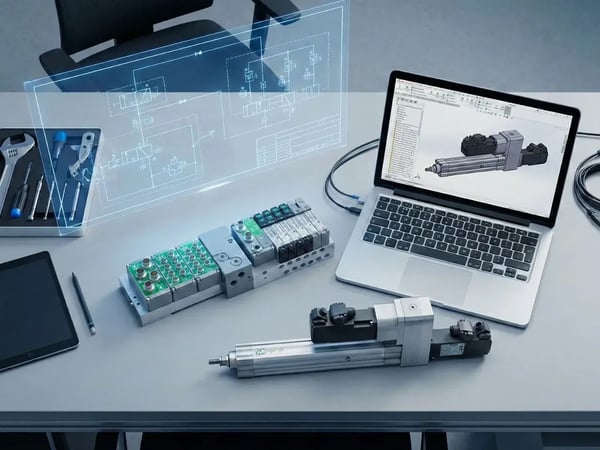
Today the picture is different. Pneumax's acquisition of AutomationWare has brought a complete mechatronic range to market — linear screw and belt axes (Gamma AW), compact electromechanical cylinders (MECH LINE – FORCE-PLUS), integrated stepper and brushless motor drives (AW DRIVES Series) — at costs that are beginning to be competitive, especially when reasoning in terms of Total Cost of Ownership rather than the purchase price of the individual component.
In parallel, end-customer specifications have become more demanding: Industry 4.0 connectivity, predictive maintenance, certified energy efficiency, noise levels below 75 dB(A) on the shop floor. Requirements that traditional pneumatics struggles to meet without the addition of dedicated sensor systems.
Technical comparison: the parameters that matter in OEM design
The synoptic table below compares the two technologies across the most relevant parameters in OEM machine design.
| Parameter | Electric axis (AW TECH, MECH, AW DRIVES) |
Pneumatic cylinder (ISO 15552) |
|---|---|---|
| Positioning | Continuous, multi-position via PLC | Point-to-point (2 fixed end stops) |
| Precision | ± 0.05 mm (belt), ± 0.01 mm (screw) | Depends on end stops and dampers |
| Format change | Via software (PLC recipe) | Mechanical (sensor repositioning) |
| Energy consumption | Only during motion | During motion + 20–30% losses |
| Noise level | Very low | High (exhaust, end stops, compressor) |
| Process data (4.0) | Position, force, current — real-time | None (without additional sensors) |
| Harsh environment robustness | Advanced systems with protective strips as barrier | High (standard IP rating, few components) |
| Integrated safety | Certified STO (AW DRIVES) | Single or double Safeline insertion valves |
| Component cost | Higher | Lower |
| 5-year TCO (multi-axis) | Lower (energy savings) | Higher (compressed air cost) |
| Communication protocols | EtherCAT, PROFINET, EtherNet/IP | IO-Link (with additional sensors) |
One element that emerges clearly is the difference in Total Cost of Ownership: in multi-axis installations running across multiple shifts, the cost of compressed air — including network losses, which typically account for between 20% and 30% — can make the investment in an electric axis recoverable within 1–2 years.
The decision matrix: four questions to guide the choice
In practice, the choice comes down to four questions to be applied to each axis of the machine.
| Design question | If the answer is… | Choose |
|---|---|---|
| Are intermediate positions required? | Yes, more than 2 positions | Electric Positions via PLC |
| No, point-to-point only | Pneumatic Simpler solution |
|
| Does the customer require process data? | Yes (Industry 4.0 spec) | Electric AW DRIVES: position, force, current |
| Is energy consumption in the specification? | Yes, or multi-shift machine | Electric ROI in 1–2 years |
| Harsh environment + simple movements? | Yes (dust, swarf, washdowns) | Pneumatic + Airplus for monitoring |
This matrix should not be treated as a rigid scheme. In many real projects the answers are mixed, and it is precisely from this complexity that the hybrid approach described in the following section arises.
The hybrid case: pneumatics and mechatronics in the same machine
The most common configuration in machines operating in the plastic and rubber injection and industrial automation sectors is neither "all electric" nor "all pneumatic". It is a hybrid approach: electric axes on critical axes — positioning, format change, value-added movements — and traditional pneumatics where robustness and simplicity are required, enhanced by the Airplus Digital Flow Sensor diagnostics for consumption and leak monitoring.
One aspect worth highlighting is the breadth of Pneumax's technological coverage in this scenario: the range spans from industrial pneumatics to AutomationWare electric axes, through PX electronics and EVO valve islands. This makes it possible to have a single technical contact for dimensioning the entire machine kinematics, without the need to coordinate separate suppliers for the pneumatic and electric sides.
The AutomationWare range available through Interfluid
Below is the complete range of AutomationWare electric axes, electric cylinders and drives available through Interfluid.
ELECTRIC AXES
- MLB belt family: sizes 45, 60, 80, 120 — additional sizes 90 and 160 for selected series
- MLS ball screw family: sizes 45, 60, 80, 120 — additional sizes 90 and 160 for selected series
- Special families: rack and pinion, roller, telescopic
ELECTRIC CYLINDERS
- MECH ball screw family:
- Value Series: sizes 16, 25, 32
- Line Series: sizes 25, 32, 50, 63
- Force and Plus Series: sizes 50, 63, 80, 100, 125, 150
- Extreme Series: ISO 5 ground screw for high loads and extreme service life
DRIVES
- AW DRIVES family: AWDL and AWDEVO series in various versions
- Analog and frequency control mode
- ModBus RTU and CanOpen CiA 402
- EtherCAT CoE, Profinet RT and IRT
Design integration: what changes on the machine layout
From a design perspective, integrating a Gamma AW axis or a MECH LINE – FORCE-PLUS cylinder into the layout is more straightforward than one might expect. The AW DRIVES unit connects to the PLC via a single network cable, eliminating the tens of wires required in traditional wiring. The certified STO (Safety Torque Off) function is already integrated: in an emergency, torque is cut without interrupting network communication, making machine recovery faster.
For machines intended for food or pharmaceutical applications, the closed profiles of the HPR and PRO series protect the internal mechanical components from dust and residues, with stainless steel strips.
For an overview of pneumatic component selection criteria for OEM machine builders, the pneumatic components selection guide is also available on the blog as a complementary reference.
A choice that depends on the application, not the technology
The comparison between electric axes and pneumatic cylinders does not produce an absolute winner. Every axis in a machine has its own operational characteristics — cycle frequency, required precision, environmental conditions, end-customer specifications — that determine which technology is best suited to that specific context.
In this scenario, Interfluid provides the technical coverage needed to support both choices: from the Pneumax pneumatic range to AutomationWare electric cylinders and axes, with the possibility of working alongside the machine builder's engineering team during dimensioning and selection — both for new machines and retrofitting projects. It is not a matter of promoting one technology: it is a matter of choosing the right one for each application.