There is a paradox at the heart of many industrial pneumatic systems. Compressed air is one of the most expensive forms of energy in a manufacturing plant — industry estimates place it at 20–30% of a facility's electricity bill — yet most machines still operate with completely "blind" FRL groups: a filter, a pressure regulator, a lubricator, and no visibility whatsoever into what happens downstream. The result: leaks accumulate undetected for months, seals wear to failure, compressors run harder than necessary, and unplanned downtime costs thousands of euros per hour. The Pneumax Airplus Digital Flow Sensor addresses this problem directly, turning the air treatment unit from a passive component into an intelligent node in the Industry 4.0 network.
Four parameters measured by a single sensor
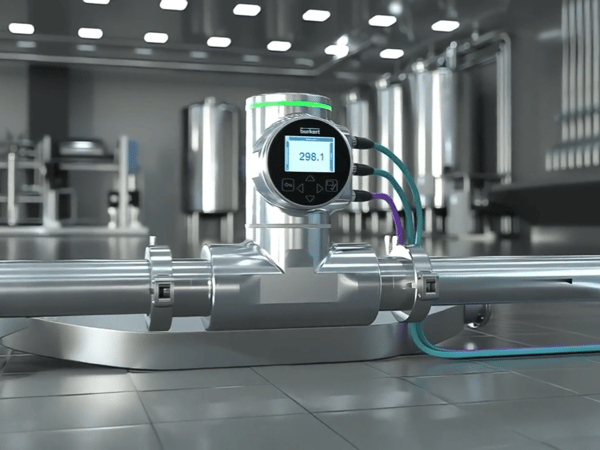
Unlike traditional flow meters that measure only flow rate, the Digital Flow Sensor simultaneously monitors four quantities: instantaneous flow rate, cumulative volume (total consumption), pressure, and temperature of the fluid. All values are displayed on the backlit graphical LCD and, more importantly, are available to the PLC via industrial Ethernet.
Among the sensor's key strengths:
- Immediate detection of leaks or circuit anomalies
- Maximum versatility: 2 independent digital outputs and 1 fully configurable analogue output
- Installation either in stand-alone mode or integrated into AirPlus Series air treatment groups
- Native integration with the main industrial Ethernet protocols
Table 1 — Technical data
| Technical data — Airplus Digital Flow Sensor (P173FS) |
| 4 measured quantities |
flow rate, cumulative volume, pressure, temperature |
| Measurement principle |
thermal bypass (insensitive to humidity and impurities) |
| Flow range |
20–3,000 l/min (Airplus groups) / 50–5,000 l/min (stand alone) |
| Accuracy |
±3% f.s. — Repeatability: 1% |
| Max pressure / Temperature |
10 bar — 0°C … +50°C |
| Power supply |
15–30 VDC — Max consumption: 350 mA |
| Protection |
IP65 (with connectors fitted) |
| Display |
Backlit graphical LCD + 3-button keypad |
From sensor to PLC in a single cable
A sensor that measures accurately but does not communicate with the control system offers visibility only to the maintenance technician physically present on site. The real strength of the Digital Flow Sensor is its native integration with industrial Ethernet protocols: EtherCAT®, PROFINET IO RT, EtherNet/IP. The protocol is selected at order stage by specifying it in the product code (suffixes EC, PN, EI).
The sensor then becomes a node in the industrial automation network in exactly the same way as a valve island or a drive. The PLC polls it cyclically, receives the data, and can react in real time. No converters, gateways, or additional analogue wiring are required.
Table 2 — Connection interfaces
| Interface |
Type |
Configurable function |
| Ethernet network |
EtherCAT® / PROFINET IO RT / EtherNet/IP / CC-Link / Field Basic |
All parameters via PLC (4.0) |
| Digital output 1 |
NPN/PNP, N.C./N.O. |
Flow switch or pressure switch (free threshold) |
| Digital output 2 |
NPN/PNP, N.C./N.O. |
Flow switch or pressure switch (independent) |
| Analogue output |
0–10V / 0–5V / 4–20mA / 0–20mA |
Instantaneous consumption (always active) |
| Power connector |
M12 male 5-pin type A |
15–30 VDC |
| Network connector |
M12 female 4-pin type D |
Cable max 100 m |
For installations without an industrial Ethernet infrastructure, the sensor also operates in analogue mode: a dedicated voltage or current output for instantaneous consumption, plus two independent digital outputs configurable as flow switch or pressure switch. This dual operating mode makes it suitable for simpler machines or for retrofit scenarios on existing systems.
Three predictive maintenance scenarios
It is useful to understand the potential of the Digital Flow Sensor through concrete applications. Three situations recur most frequently where continuous monitoring makes a measurable difference.
Leak detection on a packaging line
The machine cycles normally throughout the shift. At the end of the shift, production stops but the idle air consumption does not drop to zero. The sensor detects an anomalous residual flow and the PLC generates an alert: "Idle consumption on line 3 above 5 l/min threshold — check fittings and tubing on that section." The intervention takes place in the next shift, before the leak progresses. The same approach applies to any pneumatic system installed on a machine, regardless of industry.
Seal wear on an injection moulding press
Over time, the seals in pneumatic cylinders deteriorate. The symptom is not a sudden failure, but a gradual increase in the air consumption required to complete the same cycle. The Digital Flow Sensor tracks cumulative consumption: if for the same number of cycles the air volume consumed increases by 10% compared to the previous month, the seals are degrading. For those managing plastic and rubber injection moulding presses, this means being able to schedule the intervention at the next planned shutdown, rather than having it forced during production.
Main header monitoring
Fitted to the main supply line (5,000 l/min version), the sensor provides a complete picture: how much the entire production area consumes, in which time bands, and with what demand peaks. By cross-referencing this data with production cycles, the energy manager can identify structural waste and correctly size the compressor room.
Two configuration modes
Table 3 — Two configuration modes
| |
Local configuration |
Remote configuration (4.0) |
| How |
LCD display + 3-button keypad |
Via Ethernet network from PLC |
| When to use |
Commissioning, rapid interventions |
Smart machines, Industry 4.0 specifications |
| What you configure |
Thresholds, units, outputs |
Everything + runtime parameter changes |
| Advantages |
Immediate, no software required |
Traceable, replicable, scalable |
| Limitations |
Non-traceable, single device |
Requires Ethernet infrastructure |
Accuracy is ±3% full scale with a repeatability of 1%, the pressure range reaches 10 bar, and the IP65 protection rating (with connectors fitted) makes it suitable for direct installation at the machine, even in demanding environments.
The economic impact of an unmonitored system
It is worth considering the real cost of the absence of monitoring, starting from concrete data.
| Item |
Value |
Notes |
| Typical leak (3 mm hole, 7 bar) |
10–15 l/min |
Single leak on fitting or seal |
| Annual operating hours |
6,000 h |
2 shifts × 250 days/year |
| Air wasted per single leak |
5,000–5,500 m³/year |
Invisible without monitoring |
| Compressed air generation cost |
0.02–0.03 €/m³ |
Industrial facility average |
| Annual cost per single leak |
€100–165 |
Energy only, maintenance excluded |
| Typical leaks per machine |
5–10 simultaneous points |
Fittings, seals, tubing |
| Total annual cost (unmonitored) |
€500–1,650/machine |
Invisible and cumulative waste |
The OEM calculation
The Digital Flow Sensor costs a fraction of these annual losses. For an OEM, delivering a machine with monitoring already integrated is a technically and commercially relevant argument:
- The end customer obtains a measurable, lower TCO
- The machine builder demonstrates consideration for the operational phase, not just the point of sale
- The maintenance team gains visibility into problems that would otherwise go unnoticed for weeks
A component that changes the logic of the system
The Digital Flow Sensor fits into existing Airplus groups or can be mounted independently with G1/2" connections. It requires no dedicated infrastructure: it integrates into the automation network as any other field node.
The paradigm shift it introduces — from reactive to data-driven predictive maintenance — is not confined to pneumatics. It is the same logic that applies to hydraulic systems, vacuum systems, and any circuit in which energy consumption is an indirect indicator of component condition. For those designing machines for end customers, or reviewing the P&ID of an existing installation, integrating this level of diagnostics at the development stage is an investment with a measurable return from the first year of operation.