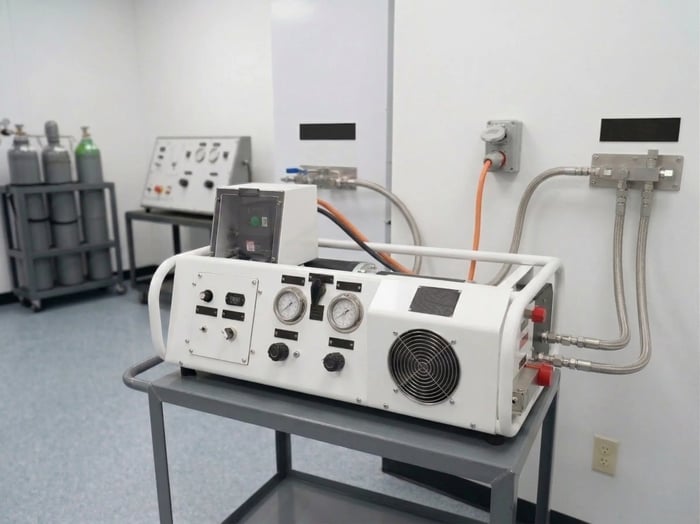
Compressing hydrogen from 218 psi — the typical outlet pressure of an electrolyser — up to 10,152 or 14,500 psi for storage or dispensing is one of the most critical operations in the entire H2 supply chain. The molecule is small, tends to permeate materials, compression ratios are high, and the operating environment is almost always classified ATEX IIC. To address this requirement without depending on compressed air and without imposing acoustic constraints on the system, the Interfluid High Pressure Division distributes the HII series 2G electric gas booster: H2 compression up to 14,500 psi, sound level of 63 dBA, no compressed air drive circuit.
Hydrogen compression: why the traditional approach falls short
Before examining the technical specifications in detail, it is worth understanding the context in which the electric booster operates. Until a few years ago, those who could not — or did not want to — rely on multi-stage reciprocating mechanical compressors had almost exclusively pneumatically driven gas boosters available to them. Reliable and intrinsically safe solutions, but ones that require compressed air drive flows in the range of 800–2,000 Nl/min and above, with noise levels that quickly become an operational constraint in laboratory or production environments.
The series 2G electric booster is designed for scenarios where these conditions are not acceptable: no compressed air network, noise restrictions, need for fine flow rate modulation. It is a machine built for compressing high-purity technical gases — hydrogen above all — with a construction that meets the requirements of the most demanding applications in the H2 supply chain.
How the 2G electric booster works
Unlike pneumatic boosters, which use compressed air on differential-area pistons, the 2G electric booster uses an electric motor (from 115 VAC single-phase to 380 VAC three-phase, 2 HP) that transmits mechanical energy via a shaft, speed reducer, and crank mechanism. The rotary motion is converted into a reciprocating action that drives the gas compression section — configurable as two-stage or double-acting.
One constructional detail worth highlighting: no belts, no external pulleys. The entire kinematic chain is enclosed, with no friction-based transmissions. This eliminates the friction and intermittent mechanical stress typical of traditional drive systems.
Thermal management: integrated cooling
Compression at 14,500 psi generates significant heat. Rather than adding water-cooling circuits to the P&ID — with all the implications in terms of footprint, maintenance, and leak risk in an H2 environment — the series 2G integrates a fan around the cylinders. The result is effective cooling without auxiliary circuits, with a direct impact on seal service life.
The series 2G range: two configurations for different requirements
The reference version for hydrogen and high-purity technical gas compression at very high pressure is the EGB100D series, available in two main configurations:
- Model 1492 two-stage: inlet from 250 psi, outlet up to 14,500 psi, flow rate 1.18 SCFM (33 LPM). This is the configuration for applications starting from low-pressure sources, such as the outlet of an electrolyser or a distribution trailer.
- Model 9292 double-acting: inlet at 6,000 psi, outlet at 13,000 psi, flow rate 12 SCFM (340 LPM). Suited when a medium-to-high pressure source is already available and significantly higher flow rates are required.
Operating speeds are selectable — for example 43, 70, 88, 115 cycles/minute (CPM) — and the Variable Frequency Drive (VFD) option allows flow rate to be modulated in line with demand. The VFD is the key element for integration into H2 compression systems where demand varies over time: refuelling stations with discontinuous load profiles, test benches with automated cycles, laboratories running varied test campaigns.
Standard equipment and options relevant to hydrogen
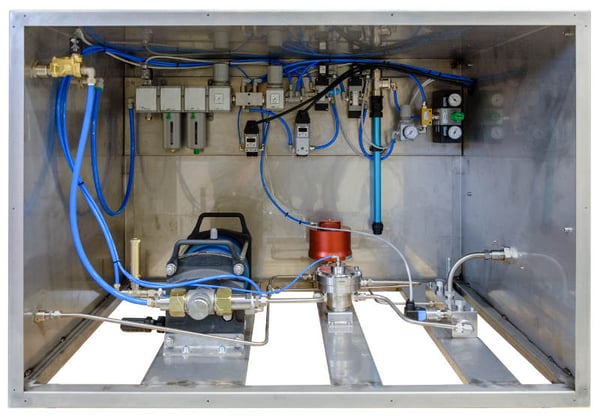
The 2G is factory-equipped with everything needed for autonomous, safe operation: high-pressure switch with automatic shutdown at set-point, manual start/stop, safety valve, dual-scale inlet/outlet gauges, 5-micron inlet/outlet filters, 6-digit hour meter, outlet needle valve, bleed valve.
The most relevant options for hydrogen applications:
- Low-pressure switch with automatic restart: the booster restarts autonomously when the source resumes supply — useful for automated cycles and repeated test sessions without continuous supervision.
- Dual-outlet pressure control: allows two outlet lines at different pressures to be managed with a single machine.
- 4-port outlet manifold: for multi-line or multi-vessel systems.
- Remote start/stop (3 m cable): for integration into control panels or workstations located away from the machine.
- Oxygen service cleaning (MIL-STD-1330D): for applications with high-purity oxidising gases.
Electric or pneumatic booster: when to choose which
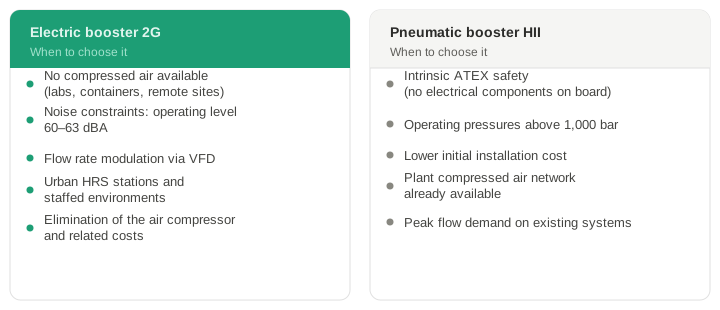
The two booster types are not interchangeable: they address different needs and — in many H2 installations — coexist in complementary roles. A detailed discussion of selection criteria is available in the dedicated article on choosing a gas booster; the key criteria are summarised below.
The series 2G electric gas booster is the indicated solution when:
- no compressed air network is available (laboratories, containers, remote sites, HRS stations);
- acoustic constraints require levels below 65–70 dBA;
- eliminating the air compressor and its associated energy and maintenance costs is a priority;
- fine flow rate control via VFD is required;
- the application is in a staffed environment where low noise is an operational requirement.
The HII pneumatic gas booster remains preferable when:
- an adequate plant compressed air network is already available;
- intrinsic ATEX safety requires the absence of any electrical components on the machine;
- operating pressures exceed 14,500 psi;
- initial installation cost must be kept to a minimum.
Note: in many H2 installations both technologies coexist — the 2G electric booster handling primary compression (low noise, efficiency, control), and pneumatic boosters covering safety lines or pressure peaks above 14,500 psi.
Applications in the hydrogen supply chain
Refuelling stations (HRS)
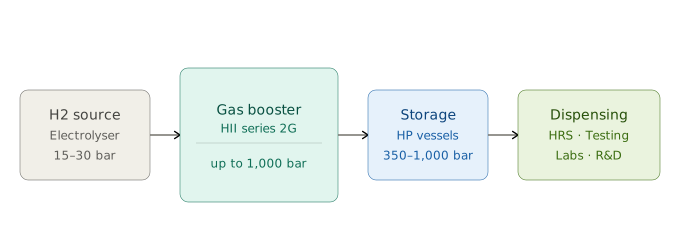
In the hydrogen and technical gas sector, the 2G is positioned at the compression stage between the low-pressure source — electrolyser or trailer — and storage vessels at 5,076 –10,152–14,500 psi. The dual-outlet option allows two pressure levels to be supplied from a single machine; the VFD adjusts flow rate in real time to match station demand.
H2 test benches
For testing vessels, valves, and components up to 14,500 psi , the 63 dBA sound level allows operators to work in close proximity to the machine without acoustic protection. The integrated hour meter and automatic restart pressure switch make test cycles repeatable and automatable — a concrete advantage during component qualification.
Research and development laboratories
In laboratories — where a compressed air network is often absent — the 2G connects directly to the electrical supply and compresses H2 from very low source pressures (as low as 200 psi). This is a common configuration in research centres, universities, and component qualification laboratories for the H2 supply chain.
Technical expertise: the value of a local partner
As Interfluid's High Pressure Division, model selection is carried out in direct technical collaboration with the HII engineering team, with full verification against the actual application requirements. The outcome is a system with the technical support needed to size and integrate it correctly into the process cycle.
With over ten years of experience in hydrogen compression and the first Italian H2 test system at 14,500 psi to its name, the expertise documented in the high pressure testing case histories on this blog is not a generic claim: it is the result of a proven technical track record on real applications. Those sizing a hydrogen compression system — from a laboratory test bench to a fully integrated HRS skid — will find in Interfluid HP a technical partner with concrete reference cases and solutions already in operation.